
 di Francesca Maria Corrao [*]
«Listening to the other seems to me to be the true elevation of man to humanity»
Gadamer
1. Words and Colors
This paper draws on Manoukian’s ‘Towards a Poetic Sociology of Iran’ (2020), and his investigation into the relationship between poetic work and social relations. As Manoukian points out the idea of challenging the persistent separation between philological studies and critical reflection refers to scholars who, like Geertz (1983), have demonstrated the importance of poetic expression for an anthropological understanding of culture. This new field of enquire has been enriched by scholarship on women literary production in the Middle East and the relevance of poetic composition for describing women and their societies, starting with Abu-Lughod (1986).
Furthemore, a recent study by Pandolfo (2018) showed how much a poem can reveal about a social reality, and how poetic imagination is connected to the complex world of relations between material culture, religious traditions, and colonialism. Etel Adnan’s texts reveal countless insights into the continuous intersections between words and the different worlds in which her verse, culture and social life are situated. Specifically, she was Christian, but she was brought up in an Islamic culture, that is the result of secular, transnational and perpetually mutating sedimentation. In the past two centuries, the evolution of traditional models accelerated following to the processes of colonial contamination, and the assimilation of other cultural models produced unprecedented results, especially among diaspora authors such as Ğubrān (d. 1943).
In one of the last dialogues with Etel Adnan on the topic of migration and creativity [1], arose my curiosity to investigate the complex relationships between diaspora authors and their multicultural environment. The specific topic of this article was also suggested by a passage in Etel’s book In the heart of the earth of another country, where she writes:
«I was constantly alarmed by what I was perceiving in an environment both old and new to me. California was on my mind, working as a filtering device. My references belonged to two worlds, and were forcing me to shift gears, so to speak, to be mobile, edgy, and most of all vulnerable. I was used to a world now remote and, at the same time, getting used to a new one that was also my old world, and somewhere, deep inside, I was alien to both» [2].
Here is the point, «I was alien to both», these few words gave me the idea to explore in her work the need to communicate the dignity of diverse cultures, facilitating an understanding of different worldviews.
To be «alien of both» was the result of having seen part of her identity vanish because of the devastating Lebanese civil war (1975-1990) and her living abroad in search of knowledge and new experiences. The Lebanese born poet studied in Paris and in the United State but never settled in the West nor in the East.
At the early age of her life the desire to meet with other cultures, and to share her experience giving her contribution through her works led her to experimenting different artistic paths. Poetry, painting and music became her privileged tools for communicating the existential condition of those who, like her, had lived in different worlds.
To Adnan «life is weaving. Notting a rope. Many ropes, each rope represent a Life» [3]. There have been many lives in the long existence of Etel Adnan. She travelled back and forth, like a migratory bird experiencing a dimension of cultural alienation as she writes
«I was central and became peripheral. My feet were adapted to the ground. While swimming circles of water originated from my body. Whoever I didn’t know didn’t exist…I carried my own space and fearlessly looked out. (…) I moved from city to city, travelled from person to person, and then I tried to define myself through writing, but that doesn’t work, no, not at all, it adds fiction to the fiction I became, and from that place where I had a sense of my absolute importance I reached a fogged Olympus from which the gods and goddesses had long departed: I am in a disorienting wilderness» [4].
She believes that wilderness belongs to us all in an age of technological terror and violence, she summons us to look for the secret of our being to root our experience in the universal human values.
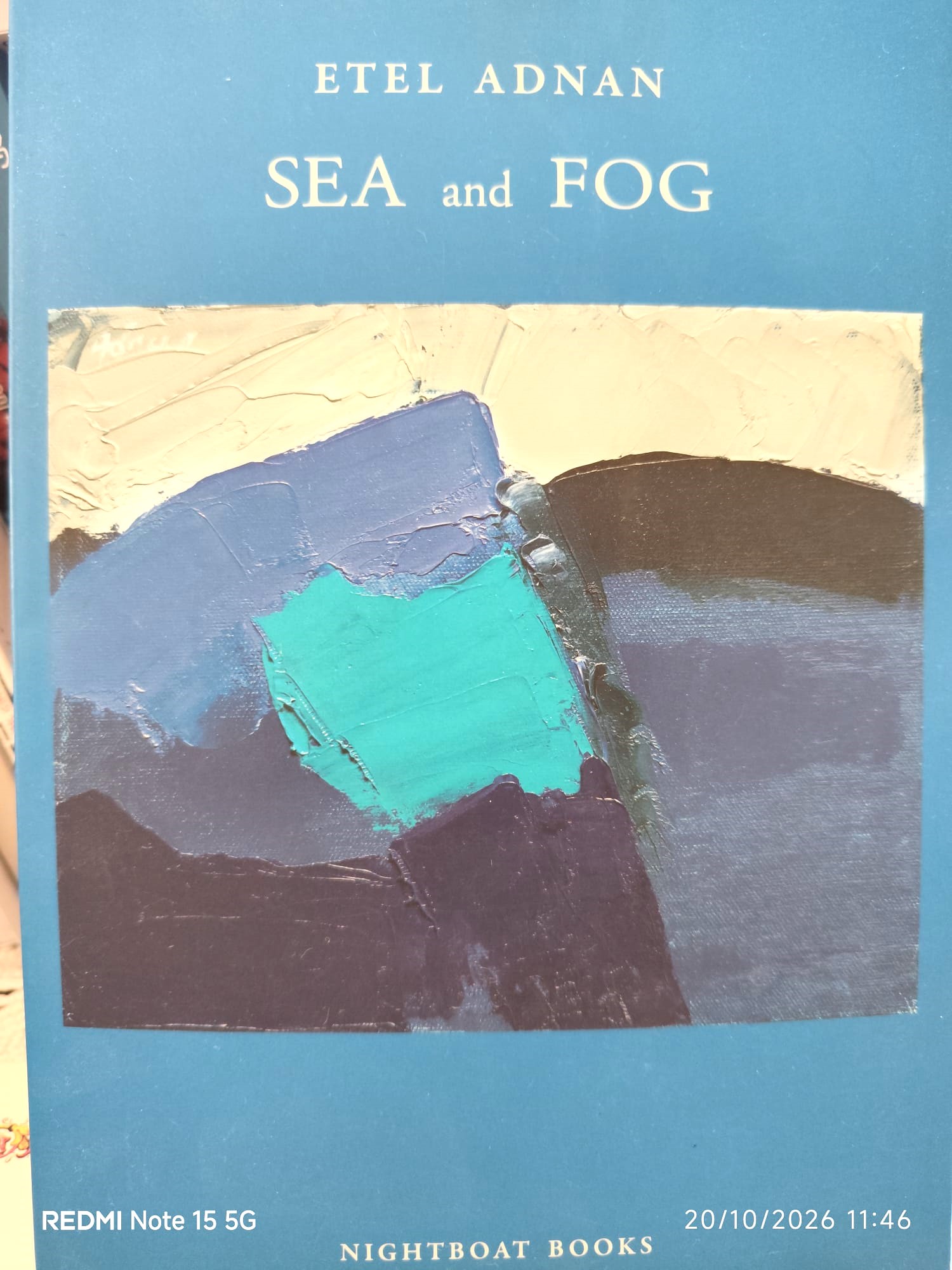 The 20th century has inaugurated the nuclear age, a time where humanity strives to give back to the human being a central role in daily life. Starting from this consideration her works witness her growing attention to the marginalized and the exiled, For Adnan, art can fill the void and help rebuild a life path by weaving webs of solidarity and comfort given by the gift of beauty. As the Japanese philosopher Daisaku Ikeda harnesses, poetry has the power to rekindle the essence of places, individuals, and messages; furthermore, He highlights poetry’s potential to awaken a sense of shared humanism[5]. This potential is what Etel Adnan wanted to convey in her artistic work.
Adnan uses the language as a tool to express her otherness; in her work the language is the instrument to communicate an inner geography where East and West coexist. She is an Arab speaker, as she is Lebanese, but she writes in French, thus breaking her natural linguistic borders her writings become universal. The plurality of her linguistic codes contributes to the uniqueness of her writing. The narrative structure is broken, as she writes a paragraph in an eastern atmosphere and then, she suddenly goes back to her temporary reality in a western world.
In her poetic world to each color corresponds different objects. As for example, in her early Beirut’s landscape, she painted three blue color Mountains over the city; Simone Fattal commenting Adnan’s first two paintings made in her studio wrote «Syrie et Liban…les montagnes du Liban sont tout en ombres et nuances blues – en raison de la proximité de la mer» [6].
In Adnan’s painting the color of Mount Tamalpais is blue, and its slopes stretch right down to the coast; but then it switches into a velvet green. The colors change according to the daylight; Adnan affirms «I am making the mountain as people make a painting» [7]. When mount Tamalpais is covered in snow, Adnan associates white with other images «White is the color of terror in this century: the great white mushroom [the atomic one], the white and radiating clouds, the White on White painting of Malevich, and that whiteness, most fearful in the eyes of men» [8].
Adnan also refers to another sensory element, hearing, when she writes «Our eyes see a special color as we pronounce differently the same word according to the sound we are tuned with» [9]. These quotations introduce us to the subject of this study, which focuses on an author whose work represents an important bridge between western and eastern cultures. Thanks to her sensitivity, she has brought the public of two worlds into dialogue, using, as mentioned earlier several sensory elements to convey diverse visions and sensations to different cultures.
2. Exiles
Hauser affirms that the place is the starting point for the vision of the world [10], but this assumes another meaning in poetry because the poet considers the shift from reality the place for imagination, and in this special place creates a new vision. When the place for us is lost, because we have gone away, or if something has happened, as a war, so that the place is lost for ever, this loss makes it incomprehensible, and we keep it alive in our memory, in our fantasy, in a dream.
For the exiled the native land is a dream still alive in the memory and becomes a place of the imagination. In this condition, a new place has been created, it belongs to another space and time and therefore structurally becomes something different and stimulates different poetical images.
The first book Adnan wrote in California was Mount Tamalpais [11] a novel in poetic prose. As in Beirut, the mountain was what impressed her most, as she wrote «The ocean led me to the mountain». The mountain – to her – is a person, the most important one, and it is placed « at the very center of her being»[12]. The mountain appears as an actor on stage « When the sun sets behind any mountain it looks as if some extraordinary things are happening […] when the car turned down D street, the mountain appeared as an Angel with a sword telling us to stop».
The poet establishes a dialogue with the mountain to sharing an inner discourse on the perennial transformation of the world and the things. She uses words and colors to read the mount and thus creates an original narrative. Furthermore, Adnan indicates that each element helps to explain the complexity of the mount, because the mountain carries within itself the philosophy of the place; the philosophy of life of the people who inhabited it. Among the elements she individuates the naming of things, as she explains describing the mount Tamalpais:
«The Indian called the Mountain Tamai/Pa, “The One close to the sea”. The Spaniard called it Tamalpais, «Bad Country»! The difference between the native and the conqueror is readable in these two different perceptions of the same reality. Let us be the Indian and let be!» [13].
The exile is her place in the sense of an ever-changing place as she explains the term «place» in the book In the Heart of the Heart of another country:
«I left this place by running all the way to California. An exile which lasted for years. I came back on a stretcher and felt here a stranger, exiled from my former exile. I am always away from something and somewhere. My senses left me one by one to have a life of their own. If you meet me in the street, don’t be sure it is me. My center it is not in the solar system» [14].
Here we notice that the romantic subject is characterized by a mystical approach which we can find in other sufi authors, both classic as Ğalāl al-dīn Rūmī (1207-1273) and modern as the Syrian Adonis (b. 1930). As for example it recalls the metaphor of the planets turning around themselves and around the sun, as the disciples turning around themselves and then around their mentor, which is the metaphor of the sufi of the Mevleviyya. In the same way Adonis in the poem «The stars», writes that the ‘stars run after him’ [15]. In these poems the dialogical relation, between the you and the I, is symbolically connected to our continuous transformation, and at the same time it alludes to the important change in mentality which occurred in Arab culture during last century.
In this poem Adnan explains her mental condition during her first travel to the West, a journey that she considered to be a «light exile», because it caused a small change/revolution in herself. An exile in search of work and in search of freedom at the same time.
For the exiled the native land is a dream still alive in the memory and becomes a place of the imagination. In this condition, a new place has been created, it belongs to another condition of space and time and therefore structurally becomes something different and stimulates different poetical images.
In the book In the heart of the heart of another city, Adnan declares that with her writing she wants to add a new point of view. As in a rhapsody her voice enters the discourse adding another rhythm to the general tone of the paragraph. There are no chapters but long paragraphs with recurrent titles as: ‘weather’, ‘place’, ‘people’, ‘politics’ and so on. In a paragraph named ‘place’ Adnan writes
«My place is at the center of things. I am writing from within the nucleus of an atom. Blood beating in my ears. Dry heat radiating from my nerves. A pressure trying to push my eyes ahead of me; they want to travel on their own» [16].
We notice that there is a symmetry between the poet and the place, as if the inner rebellion corresponds to an external explosion.
The theme of exile has also characterized much European literature of the XX century, exiled authors have added meaningful pages to the written work of our age; the symbols of the Diaspora are icons of our literature. The same can be said of the Arab artists of the Ottoman Empire who, having survived the fall of the Caliphate, were dispersed in many countries and made a great contribution to other literatures by writing in foreign languages: English or French, such as Etel Adnan or Ğubrān Khalīl Ğubrān.
 3. Culture and Nature
Nature in Adnan’s works plays an important role and some particular description remind us the Arabic poetic tradition. Right from the start, from the titles of her work we perceive that her vision is the result of a special attention given to the voices of the place. She humanizes the whole place in Mount Tamalpais, as well as in There and in Of Cities and Women. Since the preislamic age, poets had given special emphasis to the description of the landscape and many among them used it as metaphors to express their feelings. This tradition was maintained and developed until it reached the zenith with the great poems of Abū Tammām (d. 845) and alMutanabbī (d. 965); these metaphors have influenced several generations of poets up to the modern school of Iraq including Nāzik al-Malā’ika (d. 2007). Nature for the Arab traditional poet has many voices, and the same can be said for Etel Adnan’s sensibility for world melodies. In her poetic expressions culture is related to nature in both static and dynamical dimension. In practice, the poet feels that nature is mirroring the joy and the despair of the world, as she writes in describing Mount Tamailpais
The mountain changes color
Each color has a meaning
From blu as the sea
To the green as guerrilla fields
To white as the snow – cold as the corpse of the Indians.
So the mountain looks at us. One day I withstood its judgement, and I became one with it. [17]
In Etel Adnan’s poetic metaphors on nature are frequent, also when she paints a dreadful image of the war in the poem There [18]:
It rained blood. Holy cities caved in. Nobody watched the fires. Our imagination survived the onslaught; why it Inflicted upon itself such terror we can’t comprehend.
The terror is here, never relenting, the wind blowing, the sun Orbiting. Where would it be if not amongst us
The expression It rained blood it is a possible reminiscence of Mutanabbī’s verses dedicated to the victory of his master Sayf al-Dawla, in the battle of alḤadaṯ; in the ancient poem, the fortress was renamed «the red»[19] because it was colored with the blood of the victims, and the poet described the scene as if blood had rained there.
According to Adnan the violence is within human beings, she believes that it is the external manifestation of an inner ancestral wound. An archaic wound that pushes to the resolution of conflict through violence; a violence that originates in families and evolves to spread throughout society. Once again we find a parallel between the person and nature as before between the mountain and the feelings of the poetess now between the blood of the people and the rain on the mountain. Blood is death, blood is life, because death itself is a rupture, a violence. But violence is also an act of transformation that marks the life of human beings from birth to death. This kind of transformation is within things, everything is subject to the erosive effects of time. As Etel writes « Oh impermanence! What a lovely word and sad feeling» [20].

Francesca Corrao e Etel Adnan
4. Conclusion
The oneness of human being and environment runs through her entire poetic production, she translated words on painting as a sort of translation on a surface. She believed that «Painting and perception formed an unbreakable dual concept. They became interchangeable» [21].
Through many metaphors Adnan writes that nature and human life are subject to impermanence, life and death succeed each other, like day and night. Furthermore, she believes that together with poets «Painters have a knowledge which goes beyond words. Painters have always experienced the oneness of things» [22].
Emerson was Adnan’s favorite philosopher in her teaching course of philosophy at the San Raphael College in San Francisco. The American philosopher believed in the concepts of identity between divinity, humans, and nature. He had acquired this vision from Hindu and Buddhist thought; his belief in interdependence among human beings and nature, was paralleled with the idea that East and West were not separate, and the existing differences were superficial and transitory phenomena:
«Some men have the predominant perception of difference and deal with
surfaces and trifles, with coats and watches, with faces and cities … and
other men stick to the perception of identity. These are the Orientals, the
philosophers, the men of faith and divinity» [23].
Adnan in California was not only a professor of philosophy but also a poet and a painter. She appreciated the Emersonian poet Walt Whitman, who also dedicated some verses to the Islamic mystic concept of unity between man and God and nature in the poem “The Persian Lesson” and also in “Think of the Soul”, where it includes the soul, the body, and the rest of nature:
The race is never separate – neither man nor woman escapes;
Everything is inextricable – things, spirits, Nature, nations, even you –
from the preceding to come .[24].
Finally, it is worth remembering that Adnan admired the Lebanese mystic poet and philosopher Ǧubrān, and was familiar with his universalist vision. Ǧubrān in fact wrote on the same topic as we learn also from the witnessing of his friends, Mary Haskell and the writer Barbara Young, who remembered him saying “Man is nature and nature is man” [25].
Adnan in her tireless journey between East and West, has found that unity which she learned from the mystical thought of Ğalāl al-dīn Rūmī, and expressed it in both poetry and painting. Exile, breaking down boundaries and ties, led her to grasp the fundamental essence of the unity of life, which she expressed – as Ğubrān and Adonis – in the poetics of a new humanism.
Dialoghi Mediterranei, n. 82, novembre 2026
[*] Abstract
L’opera di Etel Adnan (Beirut 1925 – Parigi 2021), poeta e pittrice libanese, si distingue per la particolare creatività con cui armonizza le differenze, trasformando il dolore in bellezza. Fin dalla giovinezza, l’autrice ha attraversato contesti culturali differenti: è vissuta in un ambiente multiculturale tipico della società libanese post-ottomana; ha studiato a Beirut, nell’atmosfera occidentalizzante al tempo del mandato coloniale francese. In Francia ha poi completato la formazione letteraria prima di trasferirsi in California dove ha insegnato filosofia e ha arricchito la sua espressione poetica iniziando a dipingere. La sua formazione culturale tra Oriente e Occidente ha conferito ulteriore complessità alla sua identità con una grande pluralità di codici linguistici che ne caratterizzano la scrittura. Vivere in aree culturali molto diverse ha influenzato positivamente sia il suo linguaggio sia la sua percezione del mondo. Di origine libanese e di lingua araba, Adnan ha scritto in francese e in inglese, superando i confini linguistici originari; ciò ha reso i suoi scritti comprensibili a lettori appartenenti a latitudini lontane. La poetessa ha vissuto esperienze di vita che l’hanno vista passare da condizioni di centralità a posizioni marginali nelle società in cui ha vissuto, maturando una visione profonda e universale dell’essere umano. Etel Adnan ha trasformato il disagio derivante dai frequenti passaggi da una cultura all’altra nel nutrimento della sua creatività. Una vicenda biografica così peculiare è divenuta emblematica della sua produzione artistica che si esprime in parole e poi anche in immagini. L’alienazione e il senso di precarietà vissuti le hanno donato sensibilità e consapevolezza del doloroso straniamento derivante dall’esilio. Adnan ha così realizzato alcune delle opere più significative sulla condizione esistenziale, descrivendo, con potenti immagini poetiche e ampie pennellate di colore la tragedia umana universale, ma anche la potenza e le risorse della vita. Rompendo con la tradizione delle metafore retoriche, ha accolto le parole e i suoni del mondo e i ritmi della musica contemporanea conferendo, oltre l’appartenenza culturale, voce e dignità a sentimenti universali. Ha ricevuto molti premi, tra cui in Italia il Premio Napoli. Le sue opere principali sono state tradotte in diverse lingue, tra cui l’arabo, il tedesco e l’italiano.
Note
[1] I met Etel Adnan in Gibellina (Sicily) where I organized a poetry reading at the Orestiadi Foundation Festival in 1991. Since then, I have met many times both the artist and her life companion the artist Simone Fattal in Beirut and in Paris. Our last meeting took place in Paris in the autumn 2019. For the 1992 Festival I published an first translation of an excerpt from L’apocalypse arabe, Corrao 1991, later fully translated and published by Toni Maraini 2001. The 1991 symposium on poetry in which Etel participated is reported in Corrao 2023.
[2] Adnan 2005: xii.
[3] Adnan 2016: 16.
[4] She studied in Lebanon at the French nuns’ school and later at the Ahliya school for girls. She worked during the war at the French Information Bureau and in the Fifties, she went to study at the Sorbonne in Paris; later she moved to Berkeley and Harvard where she completed her studies in philosophy. She taught philosophy at the Dominican College in San Rafael (California). In 1972, she travelled back to Beirut, where she became the editor for the journal, L’Orient-Le Jour, until the Lebanese civil war exploded when she returned to the West.
[5] Ikeda 2024; Rees, Ikeda 2018.
[6] Fattal 2016: 11.
[7] Ibid.
[8] Adnan 1986: 19.
[9] Adnan 2016: 16.
[10] Hauser, 2001, vol. 2
[11] Adnan. 1986: 9.
[12] Ivi, 10: 15.
[13] Ivi: 15.
[14] Adnan 2005: 4.
[15] Corrao 1999: 25.
[16] Adnan 2015: 11.
[17] Adnan 1986: 28.
[18] Adnan 1997: 15.
[19] Mutanabbī 1968: 263.
[20] Corrao 2010: 23-32.
[21] Adnan 1986: 28.
[22] Adnan 1986: 27.
[23] Richardson 1995: 408.
[24] Whitman 1968: 483. Available at https://www.poetryverse.com/walt-whitman-poems/think-soul [Accessed 9th January 2025].
[25] Young 1945, 23; Hilu 1972: 296.
BIBLIOGRAPHY
ADNAN, E. La vie est un tissage. Galerie Lelong, Paris 2016.
ADNAN, E. Jebu et l’Express Beyrouth-Enfer, Oswald, Paris, 1973.
ADNAN, E. Sitt Marie Rose. Editions des Femmes, Paris, 1978.
ADNAN, E. L’Apocalypse Arabe. Papyrus, Paris 1980, The Post-Apollo Press, Sausalito, 1989. Italian translation by Toni Maraini, Semar, Roma, 2001.
- . Journey to Mount Tamalpais. The Post-Apollo Press, Sausalito, 1986.
- . The Spring Flowers Own & The Manifestations of the Voyage. The Post-Apollo Press, Sausalito, 1990.
- . Paris, When It’s Naked. The Post-Apollo Press, Sausalito, 1993.
- . Of Cities & Women (Letters to Fawwaz). The Post-Apollo Press, Sausalito, 1993.
- . There. The Post-Apollo Press, Sausalito, 1997.
- . In the Heart of the Heart of Another Country. San Francisco City, Lights Books, 2005
- . Master of the Eclipse. Interlink books, Northampton, Beirut 2009.
- . “Preface” in Haddad J., J’ai tué Schéhérazade, confession d’une femme arabe en colère. Sindbad, Paris, 2010.
CORRAO, F.M. L’Approdo di Ulisse. Il Mediterraneo dei poeti. XXX anni di poesia alla Fondazione Orestiadi, Atti dei Convegni e dei Recital di poesie. a cura di F. M. Corrao, Fondazione Orestiadi e Quaderni del battelloebbro Editore, Gibellina 2023.
- . Adonis. Nella pietra e nel vento. Mesogea Messina 1999.
- . “Gli intellettuali arabi e la guerra del Golfo”, in Labirinti, n. 1/ 1991, pp. 58-62.
- . “Etel Adnan’s breaking down the boundaries of language”, in The Marginalised. Literary and Linguistic Studies, Tenth International Symposium on Comparative Literature, Cairo University 7-9 dicember 2010, Cairo University Press, Cairo: 23-32.
FATTAL, S. Etel Adnan. La peinture comme énergie pure, l’Èchoppe, Paris, 2016.
IKEDA, D. “Life Potential”, https://www.daisakuikeda.org/sub/quotations/theme/life-potential.html, accessed August, 22nd 2024.
HANDAL, N. The Poetry of Arab Women. Interlink Books, New York, 2001.
HAUSER, A. Storia Sociale dell’arte: Rinascimento, Manierismo e Barocco. Einaudi, Turin, 2001, vol. II.
HILU, V. The Love Letters of Kahlil Gibran and Mary Haskell and her private journal. New York, Knopf, 1972.
MANOUKIAN, S., ‘Towards a Poetic Sociology of Iran’. In A. Salvatore (ed.), The Oxford Handbook of the Sociology of the Middle East, Oxford University Press 2020, 834-854.
AL-MUTANABBĪ, Šarḥ Dīwān al-Mutanabbī. Manšūrāt Dār Maktabat al-Ḥayāt, Beirut 1968.
PANDOLFO S., Knot of the Soul: Madness, Psychoanalysis, Islam, the University of Chicago Press, 2018.
REES, S., IKEDA, D., Peace, Justice and the Poetic Mind: Conversation on the Path of Nonviolence, Path Press, 2018.
RICHARDSON, R., Emerson. The mind on fire. Berkeley, University of California Press, 2018.
RŪMĪ, Ǧ. D. (1980) Poesie mistiche. Ed. transl. A. Bausani. Milano, Rizzoli.
WHITMAN 1968: 483. Available at https://www.poetryverse.com/walt-whitman-poems /think-soul [Accessed 9th January 2025].
YOUNG B. This Man from Lebanon: A Study of Kahlil Gibran. New York, A.A. Knopf, 194
_____________________________________________________________
Francesca Maria Corrao, ordinario di Lingua e Letteratura Araba, alla Luiss Guido Carli Roma, ha studiato in Italia e al Cairo la cultura del mondo arabo e islamico. Tra le sue pubblicazioni numerosi articoli in sedi internazionali e nazionali e gli approfondimenti su: La rinascita islamica (ed. Laboratorio antropologico, Università di Palermo 1985); Poeti arabi di Sicilia (Mondadori 1987, Mesogea 2001) Le storie di Giufà (Mondadori 1989, Sellerio 2002), Adonis. Ecco il mio nome (Donzelli 2010), Le rivoluzioni arabe. La transizione mediterranea (Mondadori università 2011). Assieme a Luciano Violante ha recentemente curato il volume edito per i tipi de Il Mulino L’Islam non è terrorismo e con Monica Ruocco i due volumi della Storia della letteratura araba, presso Le Monnier/Mondadori. È Presidente della Fondazione Orestiadi.
_____________________________________________________________






